

AngL0306@outlook.com
An interior fit-out for a boutique retail space specified herringbone pattern vinyl plank flooring across roughly 300 m². The contractor ordered the same quantity as a straight-lay job, opened the first cartons, and realized only then that the angled layout consumes noticeably more material. By day two the project was short by several boxes, and the re-order delay cost more than the flooring itself. That sequence repeats often enough to be treated as a rule.
Herringbone pattern vinyl plank flooring gives a space a woven, decorative finish that straight-lay planks cannot produce, but it works differently in three practical areas: product geometry, waste calculation, and installation tolerance. This article explains what to verify before ordering, how to plan the layout, and where the pattern genuinely justifies its higher cost.
Content
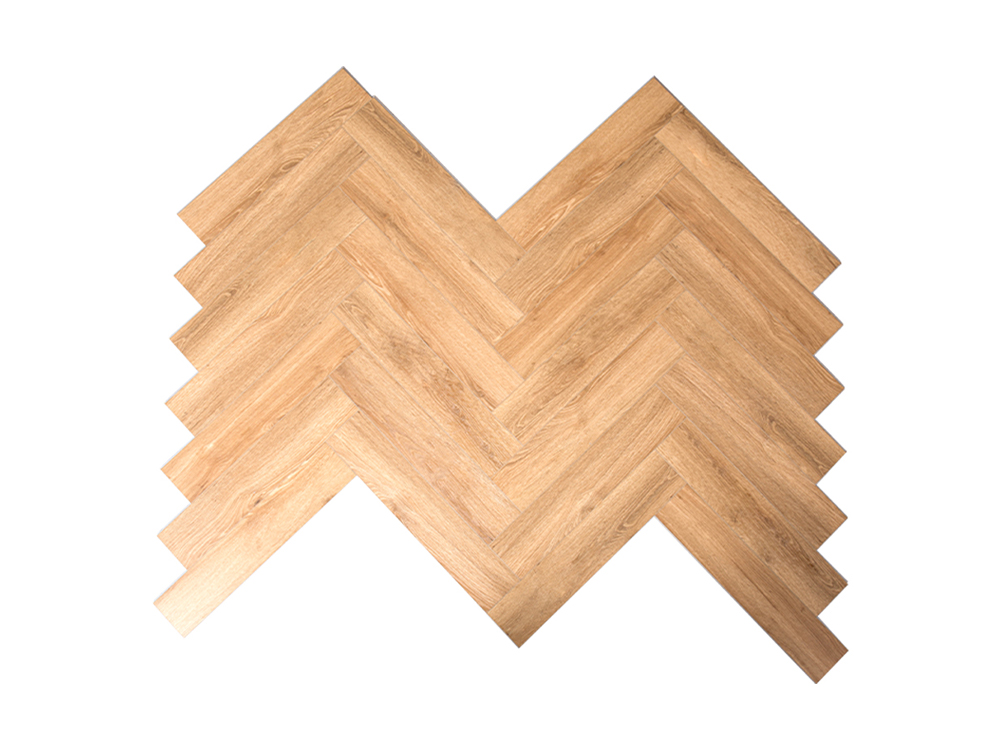
A true herringbone layout uses rectangular planks laid so that each plank meets its neighbour at 90°, forming a repeating zigzag with a staggered offset between adjacent rows. That offset is the defining difference from chevron: chevron planks are miter-cut at both ends so the rows form one continuous V, while herringbone planks keep square-cut ends and a visible step between rows.
In vinyl plank flooring, the herringbone effect depends on two factory-made details. The first is the plank ratio. Length-to-width values between 5:1 and 6:1 produce the elongated diamond rhythm most people recognize as herringbone. The second is the end cut. Herringbone planks are pre-cut at the factory so the locking profile on the short end engages the long side of the adjacent plank at a right angle. A standard straight-lay plank cannot be turned sideways to reproduce the pattern, because the click-lock geometry will not align.
The practical consequence is that herringbone pattern vinyl plank flooring is a designed product line, not a site-made arrangement. The wear layer, the core, and the locking system are all engineered as one piece, and each deserves attention during specification.
Appearance drives most selections of herringbone pattern vinyl plank flooring, but long-term performance still comes down to ordinary product variables. A herringbone floor contains many more locking points per square metre than a straight-lay floor, which raises the mechanical demands on the click system and makes dimensional stability the priority.
| Specification | Why it matters | Recommended threshold |
|---|---|---|
| Wear layer | Determines scratch and scuff resistance under foot traffic | 20 mil (0.5 mm) residential; 28 mil (0.7 mm) commercial |
| Core type | Controls rigidity, waterproofing, and indentation resistance | SPC rigid core for point loads and temperature changes |
| Plank dimensions | Sets the proportion and visual rhythm of the layout | Length-to-width ratio between 5:1 and 6:1 |
| Locking system | Holds the numerous short-end joints tight over years of use | Ask the supplier for lock pull-force test data |
| Surface profile | Micro-bevel or square edge determines how each joint reads visually | Micro-bevel for a crisp pattern; square edge for a flat continuous look |
| Batch number | Guarantees colour and gloss consistency across cartons | Verify every carton; order the full quantity from one batch |
Two rows deserve extra attention. The wear layer decides whether the floor still looks new after two years of shoes, chairs, and display racks; a retail or hospitality application should not drop below 28 mil. The locking system matters even more in herringbone than in straight lay, because every square-cut end is a separate locking point. A weak lock shows up as clicking, gapping, or broken tabs within the first year.
The material cost is usually the first number in the budget, but installation is where most herringbone projects go over. The margin for error starts on the subfloor. Rigid-core vinyl products normally require flatness within 3 mm over 3 m, and herringbone leaves less room for deviation because the short-end joints sit close together and transmit any floor movement directly into the locking system. Self-levelling compound is a standard line in a herringbone specification, not an option.
Waste is the second cost driver. A straight-lay vinyl job in a rectangular room typically budgets 5-8% for cutting waste. Herringbone changes that calculation because every wall run and every column requires a cut at an angle. Plan for 10-15% in simple rectangular rooms and up to 20% in spaces with multiple doorways, angled walls, or heavy perimeter detail.
Layout planning is the third factor. A herringbone floor should never be started against the longest wall and simply run across the room. Mark the centre line, dry-lay two full rows to establish the repeating unit, then work outward so the pattern stays symmetrical and the cut pieces at the perimeter do not dominate the visual rhythm.
Acclimation and transitions round out the planning stage. Follow the manufacturer's instruction for room-temperature conditioning, because some click-lock products require a stabilisation period and others do not. Transitions need to be defined before the first box is opened: a herringbone floor creates many cut edges along doorways, and the joint between the herringbone room and the next floor has to be capped with a profile. A T-molding is the standard answer when two floors of similar height meet under a door.
Do not assume that a soft underlayment improves comfort under a click-lock herringbone plank. A thick pad allows vertical movement, which flexes the short-end locks and can fracture them over time. If the manufacturer's datasheet does not include an underlayment, install directly on the prepared subfloor.
Herringbone pattern vinyl plank flooring is fundamentally a design tool, so its value is highest where the floor participates in the image of the space: boutique retail stores, hotel lobbies, showrooms, cafes, and residential entryways or studies. In large open areas the pattern reads as a texture; in very small rooms it can overpower the space. Use it where the floor will be seen at close range.
Orientation changes the perceived shape of the room. Laid parallel to the main sightline, the herringbone lengthens the space; laid across the sightline, it visually widens it. That makes the pattern a genuine optical tool, provided the product remains dimensionally stable enough to keep the geometry true for years.
For commercial projects, specify a rigid-core SPC plank rather than a flexible LVT. Retail racks, chair legs, and display bases create concentrated point loads, and a rigid core resists indentation while keeping the short-end joints closed under temperature swings. A herringbone SPC product with a commercial-grade wear layer is the specification to ask for when the floor has to carry real traffic.
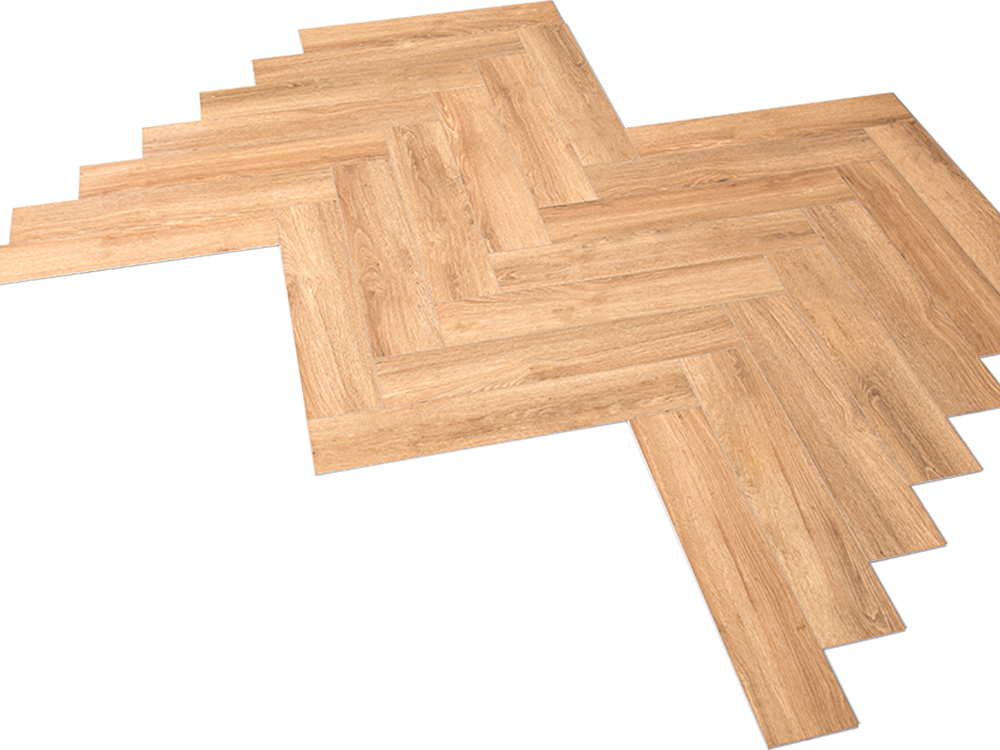 Herringbone SPC Flooring with Rigid Core and Click-LockThis rigid-core SPC plank suits commercial traffic with a customizable wear layer and waterproof, fire-resistant build. Its click-lock system enables herringbone layouts, making it ideal for high-end retail and hospitality projects.View Product →
The most frequent errors in herringbone flooring purchases are not about colour or finish. They come from treating the product like a straight-lay plank:
Herringbone pattern vinyl plank flooring is not a variant of straight-lay plank; it is a different product geometry with different waste mathematics and stricter installation planning. Budget for 10-15% waste, verify the wear layer and the locking system on paper, decide the transitions before the first carton is opened, and order the entire quantity from a single production batch.
Once installed, the daily care routine is no harder than for any other vinyl plank floor. The main risk is using the wrong cleaning tools and wearing down the bevel edges; the specific tools and solutions that protect the wear layer are described in our flooring maintenance methods guide.
For projects where herringbone is part of a larger flooring programme, it pays to work with a manufacturer that can combine the herringbone plank, transition strips, and complementary wall panels in one delivery. Anhui Hanhua Building Materials Technology Co., Ltd., the company behind the Swanflor brand, has produced vinyl and rigid-core flooring since 1992, exporting mainly to North America, Australia, and the EU. Its production base in Anhui runs an annual capacity of more than six million square metres of flooring, which matters when the same herringbone product has to be supplied consistently across multiple stores or construction phases. The full catalogue is published on the manufacturer's site.


 皖公网安备34182102000331号
 Indoor Plastic Wood Flooring Manufacturers

 English
 Español
 Deutsch