

AngL0306@outlook.com
Content
Hybrid wood-plastic flooring—commonly abbreviated as WPC or EWPC—represents a category of engineered flooring that combines the visual warmth of natural wood with the dimensional stability and moisture resistance that solid timber cannot provide. The term "hybrid" captures the core engineering principle: multiple materials are combined, each contributing properties the others lack, to produce a floor that outperforms any single-material alternative in specific performance categories.
At its most fundamental level, hybrid wood-plastic flooring uses a composite core made from wood fibers (or wood flour) blended with thermoplastic resins—typically polyvinyl chloride or polyethylene. This core is neither wood nor plastic in isolation; it is a new material whose properties emerge from the interaction of its components. The wood fiber contributes stiffness, a degree of natural acoustic damping, and a substrate for realistic wood-grain printing. The plastic matrix provides waterproofing, dimensional stability under humidity changes, and resistance to biological degradation that neither pure wood nor pure plastic achieves alone.
What differentiates premium hybrid WPC from commodity alternatives is the structural engineering that surrounds this core. The number of layers, the symmetry of the layer stack, the wear layer thickness, and the inclusion of real wood veneer surfaces define a wide performance range within the WPC category—from basic click-lock planks to fully engineered floor systems with multi-decade performance warranties. Explore our complete WPC flooring collection spanning classic and co-extruded constructions across residential and commercial performance tiers.
Understanding the multi-layer structure of hybrid WPC flooring is the key to evaluating product quality and matching a specification to a performance requirement. A fully engineered hybrid WPC plank typically comprises four to six functional layers, each with a defined role:
One of the most technically significant—and least discussed—aspects of premium hybrid WPC flooring is the structural architecture of the composite core itself. Standard WPC products use a simple single-layer core assembly. Premium engineered products use an ABA structure: a symmetrical three-layer stack in which a central core layer (B) is sandwiched between two outer layers (A) of identical or matched composition and thickness.
The engineering rationale is dimensional stability. Any composite material expands and contracts with changes in temperature and humidity. In a single-layer core, differential stress between the top and bottom surfaces—caused by the different materials above and below the core, or by asymmetric moisture exposure—can induce a bending moment that causes the plank to bow or cup over time. This is the primary cause of the plank-lifting and edge-gapping that characterizes lower-quality floating floor installations after their first full seasonal temperature cycle.
In an ABA structure, the symmetrical layer arrangement neutralizes this differential stress. Because the materials and thicknesses above and below the central B layer are matched, the bending moments induced at the top and bottom surfaces cancel each other out. The plank remains dimensionally stable—flat and locked against the subfloor—across a wide range of environmental conditions. This is not a minor performance refinement: it is a fundamental structural improvement that determines whether a floor remains flat and gap-free after five years in a room with seasonal temperature swings of 20°C or more.
The ABA principle extends to products with a PVC balancing layer added below the core assembly. This bottom balancing layer mirrors the PVC content of the upper layers, ensuring that hygroscopic response—the dimensional change associated with humidity rather than temperature—is also symmetrical and self-canceling. Our ABA structured EWPC flooring applies this symmetric architecture to a co-extruded WPC core, combining the dimensional stability advantage of the ABA structure with the surface protection of an integrated polymer cap layer.
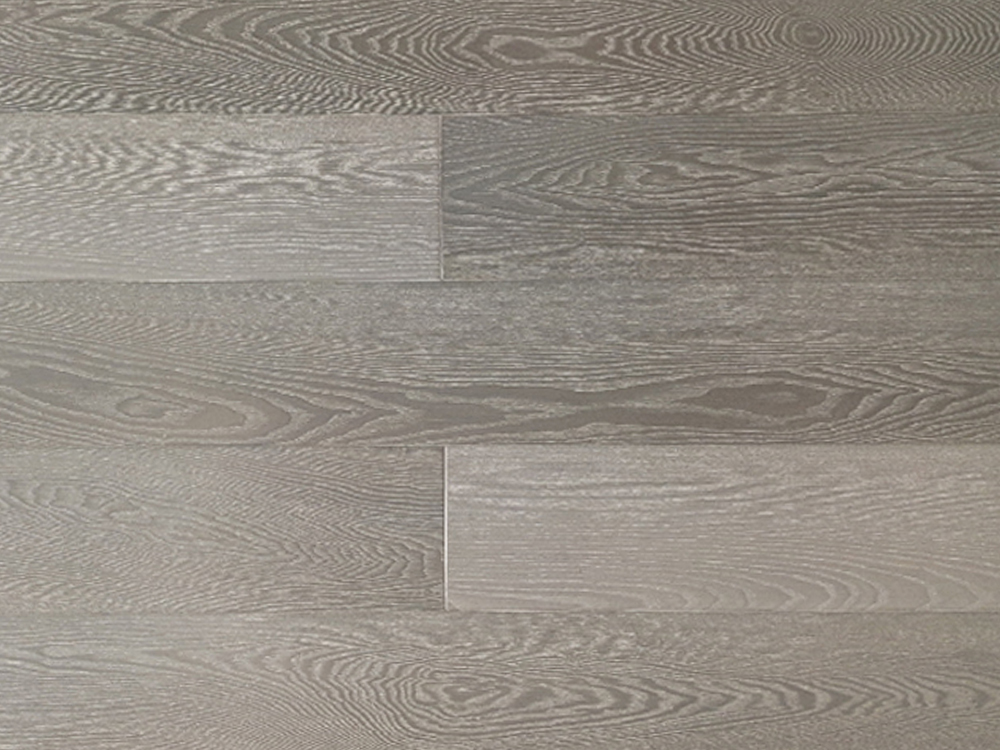
At the highest performance and aesthetic tier of hybrid wood-plastic flooring sits a product category that digital printing cannot replicate: solid wood veneer WPC, in which a genuine slice of natural hardwood is bonded to the engineered composite core as the visible surface layer.
The engineering rationale for this construction combines the best characteristics of both material worlds. The composite core provides the waterproofing, dimensional stability, and click-lock installation convenience that solid hardwood flooring cannot offer. The real wood veneer—typically 0.6 mm to 2 mm of genuine oak, teak, walnut, or other premium species—provides the authentic grain pattern, tactile warmth, and natural variation that even the most advanced digital printing cannot fully replicate. Because no two cuts from a natural wood log are identical, a veneer WPC floor has the genuine randomness and depth of appearance that distinguishes real wood from its simulations.
Solid wood veneer WPC is the specification chosen when a project requires the waterproof installation capability of an engineered composite—allowing use in kitchens, bathrooms, and below-grade spaces where solid hardwood is prohibited—combined with a genuine wood surface that satisfies a premium design brief. It eliminates the compromise historically required between natural material authenticity and practical installation performance. Our solid wood veneer WPC flooring is available in oak, teak, and custom species configurations, with each plank carrying a unique natural wood surface over a stable ABA-engineered composite core.
The primary care consideration for veneer WPC is that the real wood surface, while protected by a factory-applied lacquer, should not be subjected to standing water or abrasive cleaning tools that would damage a hardwood floor. The composite core is fully waterproof; the wood veneer surface requires the same reasonable care as any finished hardwood flooring.
Hybrid wood-plastic flooring exists within a wider family of rigid-core and flexible-core engineered flooring products. Understanding where WPC sits relative to SPC (Stone Polymer Composite) and LVT (Luxury Vinyl Tile) is essential for making an informed specification decision:
| Specification Factor | Hybrid WPC | SPC (Stone Polymer Composite) | LVT (Luxury Vinyl Tile) |
|---|---|---|---|
| Core composition | Wood fiber + thermoplastic resin | Limestone powder + PVC + stabilizers | PVC with plasticizers (flexible or rigid) |
| Core rigidity | Rigid but slightly flexible | Very rigid and dense | Flexible (standard) or semi-rigid (rigid core) |
| Comfort underfoot | Excellent — softer than SPC | Good — firmer than WPC | Good (flexible) to Moderate (rigid) |
| Waterproof | Yes — 100% waterproof core | Yes — 100% waterproof core | Yes — fully waterproof |
| Subfloor tolerance | Good — absorbs minor subfloor imperfections | Limited — requires flatter subfloor | Good (flexible) to Moderate (rigid) |
| Thermal stability | Good — slight expansion under heat | Excellent — very low expansion coefficient | Moderate — higher expansion in heat |
| Sound absorption | Good — wood fiber core dampens impact sound | Moderate — denser core transmits more impact | Good (with attached pad) |
| Typical thickness | 6–12 mm | 4–8 mm | 2–5 mm (standard); 5–8 mm (rigid) |
| Price tier | Mid–High | Mid | Low–Mid |
| Best for | Living rooms, bedrooms, kitchens; comfort priority | High-traffic commercial; extreme temperature environments | Rental properties, budget renovations; wet areas |
The practical selection rule: choose WPC when underfoot comfort and acoustic performance are the primary criteria, and the installation environment has moderate temperature variation. Choose SPC when thermal stability under extreme temperature swings is critical—large open-plan commercial spaces, conservatories, or regions with significant seasonal temperature range. Choose LVT when budget is the primary constraint and performance requirements are moderate. Explore our SPC flooring range for applications where the denser stone-polymer core better suits the project's dimensional stability requirements.
Hybrid WPC flooring's combination of waterproofing, comfort, and installation flexibility makes it broadly applicable across residential and light commercial environments. The following contexts represent its strongest performance cases:
Hybrid WPC flooring is installed as a floating floor: the planks interlock with each other via click-lock tongue-and-groove profiles but are not bonded to the subfloor. The floor "floats" as a unified assembly that can expand and contract slightly as a unit in response to temperature and humidity changes. This installation method eliminates the adhesive application, drying time, and permanent commitment associated with glue-down installation.
Critical subfloor requirements before installation begins:
One of the primary commercial advantages of hybrid WPC flooring relative to solid hardwood is the elimination of refinishing from the maintenance schedule. The wear layer applied at manufacture is the final surface for the floor's service life—there is no sanding, staining, or re-coating cycle. Maintenance is limited to the following routine practices:


 皖公网安备34182102000331号
 Indoor Plastic Wood Flooring Manufacturers

 English
 Español
 Deutsch